
The Inland Taipan (Oxyuranus microlepidotus)
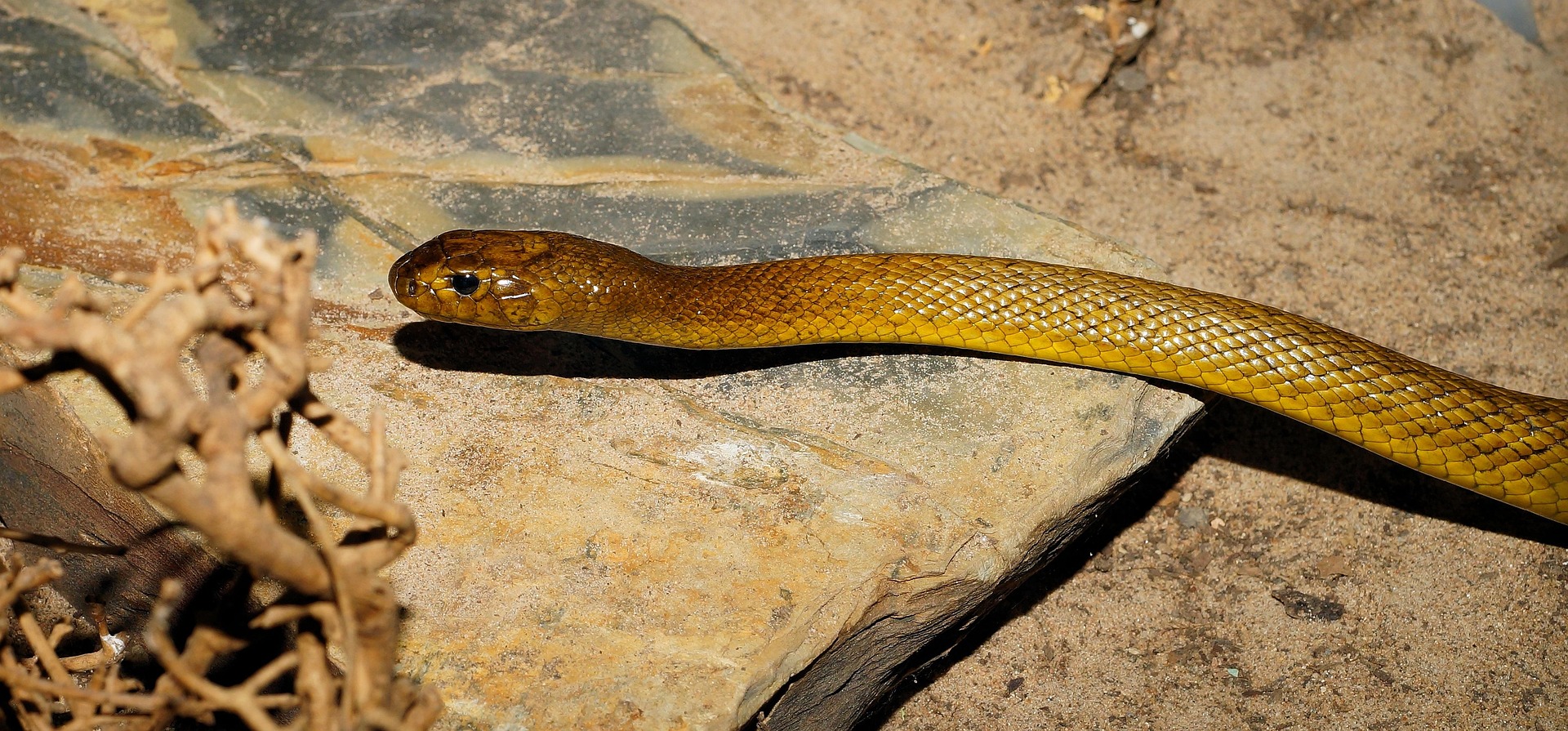
Inland taipan, or Oxyuranus microlepidotus, if you want to sound fancy, are the epitome of snakes. They are one of the most mysterious, crazy, and finest works of nature, a simple bleak emblem of the Australian Outback.
Over time, they have built their reputation on a chilling fact rather than their looks or anything else, their venom. They are known to have the deadliest bite among all snake species. Nevertheless for all its deadly venom the inland taipan is not an aggressive snake or vengeful one, it is an enigmatic animal of restraint, a restrained onlooker at the domain over which it exercises a type of covert hegemony.
It is not a flashy snake; its beautiful coloration perfectly fits with its environment of operation, which is the hot, dry regions of Central Australia. Its scales change color due to the climatic condition; it is olive-brown perhaps due to the extreme heat in the summers and a much darker shade in winter. This kind of seasonal camouflage is not just a splendid color display, but may often represent a powerful weaponry of adaptation and survival. Where all creatures lack the resilience necessary to survive, the inland taipan’s decision to blend with the desolate redness of the Outback puts it at an advantage against both competitors and food sources. It is not a snake that comes out into the open, boasting of its existence –it is one that secretly lingers. As for their physical appearance, Inland taipans are usually between 2 -2.7m and weigh 1–2kg.
They are the cousins of the famous Indian Cobras and Banded Krait, coming from the same family elapid. Surprisingly their geological distance is quite much, so you may wonder, why they’re found on different continents. Well, that’s another part of our Snakology Writings, and we’ll probably discuss it someday.
Unlike anacondas, it’s not their physical strength and power that defines them, it’s their venom.
Taxonomy
Kingdom : AnimaliaPhylum : Chordata
Class : Reptilia
Order : Squamata
Suborder: Serpentes
Family : Elapidae
Genus : Oxyuranus
Species : Oxyuranus microlepidotus
The inland taipan’s venom consists of:
Neurotoxins: Presynaptic neurotoxins; paradoxin (PDX), and postsynaptic neurotoxins; Oxylepitoxin-1,
alpha-oxytocin 1, alpha-scutoxin 1 — affecting the nervous system.
Hemotoxins (procoagulants) — affecting the blood
Myotoxins — affecting the muscles
Possibly nephrotoxins — affecting the kidneys
Possibly haemorrhagins — affecting the blood vessels (endothelium)
Hyaluronidase enzyme — increases the rate of absorption of venom
Sounds confusing, right? Let’s ease up a bit. One single bite from an inland taipan is potent enough to kill around 200,000 mice or 100 fully grown humans. The venom is swift, most of it attacks the nervous system and the other part triggers internal hemorrhaging. For the taipan, however, this has to be optimum efficiency. In Outback, a hint of energy conservation is all that one can afford; a moment of hunting without much rigor is a luxury.
Even though having one of the highest venom potency levels, it’s shy like its cousin, Banded Krait. Both of them are quite shy snakes and try to avoid interaction with humans, but if they feel threatened they won’t return. There are very few resorts of Inland Taipan bites and due to the availability of their antivenom, the fatal rates are even lower.
They breed around August to September. The Inland Taipan are oviparous, which means they lay eggs. The females lay around 10–20 eggs, depending on their physical capability. The eggs usually hatch within 60–70 days and young, beautiful snakes are born, although they contain the same amount of potent venom as the fully grown ones. They are fully dependent on themselves as the mother leaves them and goes away. Due to harsh environments and potential predators, all of them do not survive.
But for all its efficiency as a predator, the inland taipan is not invulnerable to harm. It is not immune to the gradual and continuing dangers of habitat loss and fragmentation, or climate change and human intrusion. The wasteland and the craggy rock formations it inhabits have gradually been advancing on the predator that proves so elusive, providing it with less and less territory in which to hunt. Its existence proves that there is always a natural equilibrium, which people are always mistaken for interfering with.
There is far more to the inland taipan than the snake: it is a monument to evolutionary foresight, an organism that couldn’t be better adapted to its habitat. It requires no forceful aggression or towering dimensions to impose its authority based on relentless orderliness and planning. The correct preservation of the inland taipan is not only about the specific protection of the representative inhabitant of the Australian outback but also the conservation of the piece of the preserved wildness which people still feel respect for. In the tale of this enigmatic serpent lies a lesson for us all: true power is not anarchy but a proper, well-timed, and well-executed authority over one’s sphere of influence.
(According to IUCN, they are one of the least concern snakes)