
The Jamesons Mamba
Physical Description:
People generally think of a black mamba whenever the term mamba comes. But to be frank, it’s probably one of the most beautiful mamba species. It kinda looks like the Pokémon Rayquaza. They were first discovered in 1845 by a Scottish zoologist Thomas Traill. In 1943, they were derived into 2 subspecies by Loveridge- Easten Jameson’s Mamba(Dendroaspis jamesoni kaimosae), and
Western Jameson’s Mamba (Dendroaspis jamesoni jamesoni).
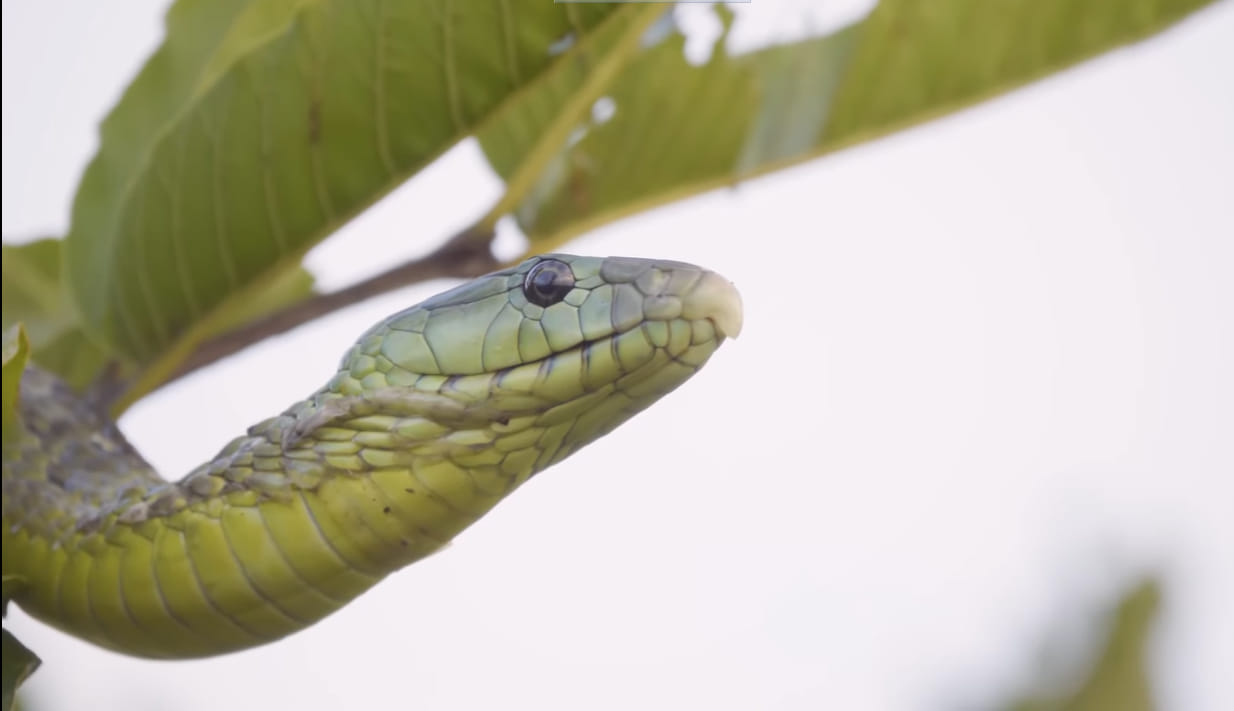
Jameson's mamba is a long and slender snake with smooth scales and a tail which typically accounts for 20 to 25% of its total length. Adults typically reach lengths of 15- 2.1 meters but there are reports of them growing up to 2.5 meters long.
Adults tend to be dull green across the back, blending to pale green towards the underbelly with scales generally edged with black. The neck, throat and underparts are typically cream or yellowish in colour. Jameson's mamba has a narrow and elongated head containing small eyes and round pupils. Like the western green mamba, the neck may be flattened. The subspecies D. jamesoni kaimosae, which is found in the eastern part of the species' range, features a black tail, while central and western examples typically have a pale green or yellow tail. The thin fangs are attached to the upper jaw and have a furrow running down their anterior surface.
Habitats and Habit:
Their name tells us about their range of habitation.The Eastern Jameson's Mamba is mostly found in countries like Kenya, Tanzania, Uganda, and Rwanda whereas the Western Jameson's Mambas have a larger territory, they’re found in countries like Nigeria, Cameroon, and Gabon.
They are primarily found in rainforests, wooden jungles and highland savannas but also might be found in secondary jungles and deforested areas.
Taxonomy
Kingdom: AnimaliaPhylum: Chordata
Class: Reptilia
Order: Squamata
Suborder: Serpentes
Family: Elapidae
Genus: Dendroaspis
Species: Dendroaspis jamesoni
Behavior and Diet:
Due to their arboreal nature, they feed a lot on birds, bats, squirrels, and animals like that. They are arboreal, which means they spend most of their lives in trees. They are edgy, very fast-moving snakes. Jameson's mambas come down to the ground only to bask or move to another tree. They are solitary and interact with each other only during the mating season. Jameson's mambas are active diurnal hunters and chase prey, similar to other mamba species. When prey is caught, mambas will strike until the prey dies. When these snakes feel threatened they will flatten their neck in mimicry of a cobra, and their body shape and length give the ability to strike at a significant range. Jameson's mambas are not typically aggressive in nature and will almost always attempt to escape.
Reproduction and Growth:
There’s no sexual dimorphisms with the mamba so the only way to sex them is by probing. These mambas are ovoviviparous. This means they carry eggs that hatch inside their bodies, then give birth to live young snakes within 5 months of mating .