
The Reticulated Python (Malayopython reticulatus)
Distribution and Habitat:
This species is native to Southeast Asia, with a range that includes Indonesia, the Philippines, Malaysia, Thailand, Myanmar, Cambodia, Laos, Vietnam, and parts of southern China. It also inhabits numerous smaller islands across the Sunda Shelf. Verified habitat studies show that the Reticulated Python occupies a wide range of environments—from lowland rainforests and peat swamps to agricultural zones and peri-urban landscapes. Its tolerance of human-modified areas contributes to its persistence even in densely populated regions.
Morphology and Sensory Adaptations:
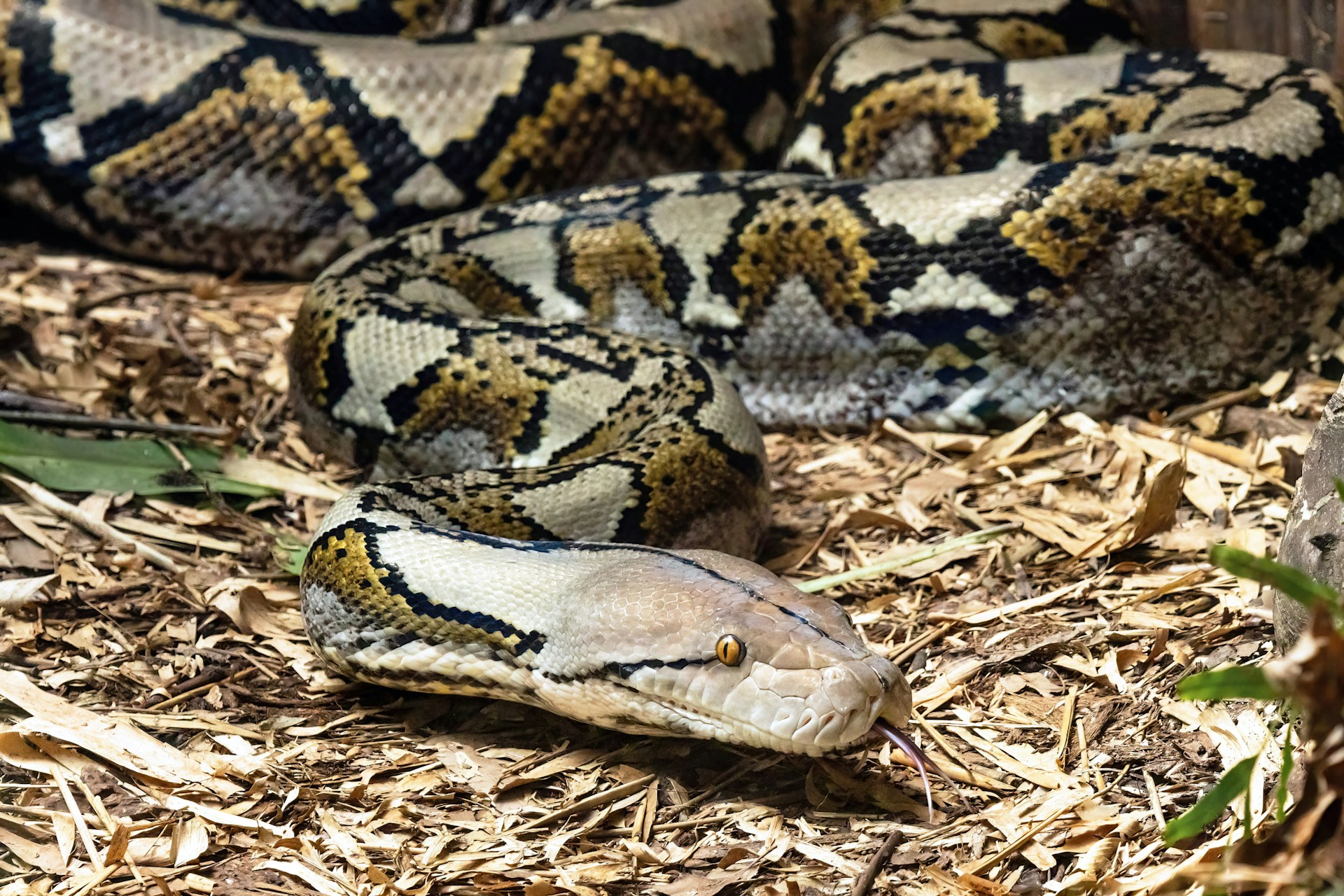
The species derives its name from its complex “reticulated” pattern: a geometric network of dark lines overlaying gold, olive, or brown scales. This pattern serves as highly effective camouflage within dappled forest light. Anatomically, the Reticulated Python is slender relative to its length, particularly when compared with bulkier constrictors like the Green Anaconda. It retains vestigial hind-limb spurs and is equipped with recurved teeth adapted for seizing and anchoring prey.
Thermal imaging pits along the upper and lower labial scales allow the python to detect infrared radiation, a trait well-documented in boid and pythonid research. This adaptation is crucial for nocturnal hunting, especially when targeting endothermic prey.
Taxonomy
Kingdom: AnimaliaPhylum: Chordata
Class: Reptilia
Order: Squamata
Suborder: Serpentes
Family: Pythonidae
Genus: Python
Species: Python reticulatus
Behavior and Diet:
Reticulated Pythons are primarily ambush predators. Telemetry and stomach-content studies show that juveniles feed largely on rodents, small birds, and bats. Adults expand their diet to include civets, primates, pigs, and deer, depending on local availability. Their ability to take relatively large prey is supported by highly flexible cranial ligaments and an efficient constriction system that rapidly induces circulatory arrest. This mechanism has been verified across pythonid species through physiological studies measuring blood-pressure collapse in prey.
In human-dominated landscapes, their predation on commensal rodents can have ecological benefits, although conflict sometimes arises around poultry farms.
Reproduction and Growth:
Like other members of Pythonidae, the Reticulated Python is oviparous. Females lay clutches that typically range from 15 to over 80 eggs, depending on size and nutritional state. Documented studies report maternal brooding behaviour, with the female coiling around the eggs and producing heat through muscular micro-vibrations when ambient temperatures fall below optimal incubation levels.
Growth rates are rapid during early life stages. In captivity, where food is abundant, individuals can reach over 4 metres within a few years. Wild growth is more variable and generally slower.
Conservation Status:
According to the IUCN Red List, the species is classified as Least Concern. Its wide distribution and ecological adaptability contribute to this status. However, it is heavily exploited in the international skin trade, particularly in Indonesia and Malaysia. Habitat loss, although significant in some regions, has not yet caused documented large-scale population declines. Continued monitoring is recommended, especially on islands where small, isolated populations may be more vulnerable.
These majestic creature serve as apex or meso-predators in their ecosystems, regulating populations of rodents, small mammals, and even larger ungulates. This role is vital for maintaining ecological balance, preventing overgrazing, and indirectly supporting plant diversity. By controlling prey populations, pythons help maintain the health of forest and wetland ecosystems. Moreover, Reticulated Pythons act as bioindicators. Healthy populations often reflect intact habitats and functioning ecosystems. Their disappearance, conversely, signals environmental stressors such as deforestation, pollution, and overhunting.