
Physical Description
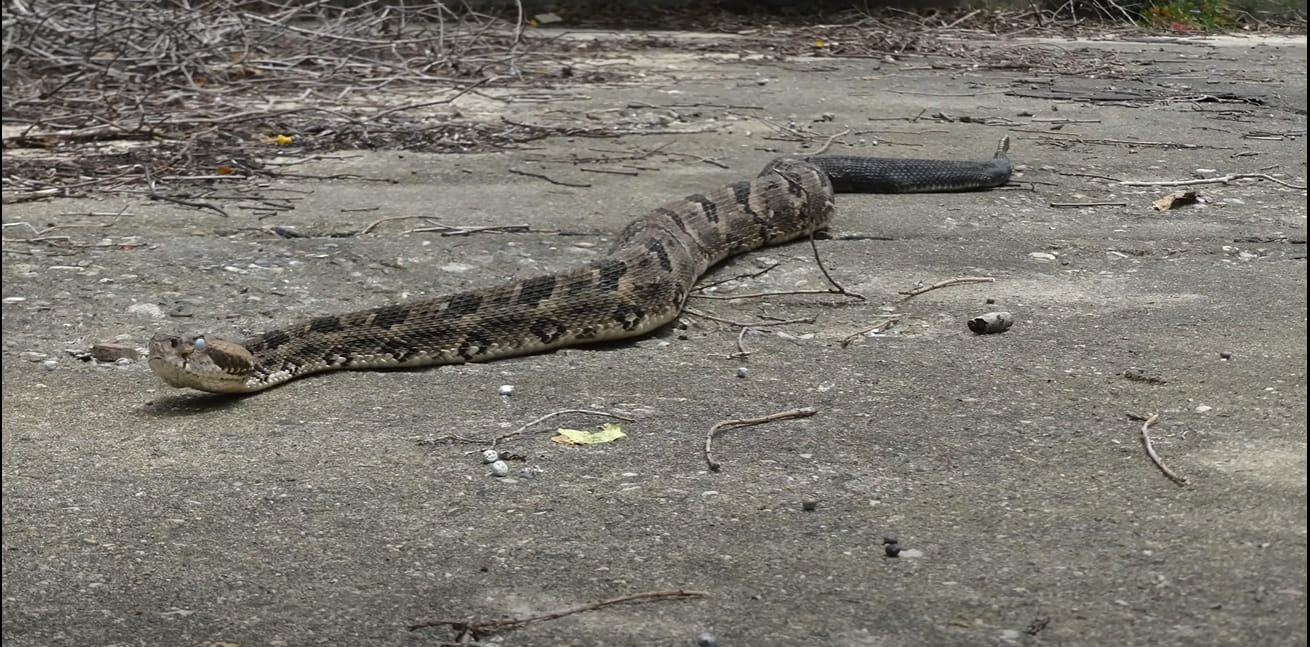
They are of the most charismatic pit vipers found . These large, heavy pit vipers vary in coloration. Color can vary between yellowish brown and dark gray, with thick black or brown stripes along their back.
Unlike the other pit vipers , their head is much much wider than the neck that leads up to it , which makes them easy to identify . They have a large , bulky head.
They have a huge rattle. Basically loose sections of the tail made of keratin (the same substance as human hair and fingernails) form the characteristic rattles at the tip of the timber rattlesnake's tail. When threatened, it props itself up and shakes its rattle, which hits the layers and creates the rattling sound . They also shake their rattles as a warning sign .
Adults typically reach lengths of 2.5-5 feet, but there are reports of timber rattlesnakes growing up to 6-6.5 feet long, although not well documented.
Habitat
These snakes have a wide distribution across the eastern half of the United States. Their range extends from eastern Kansas, Texas, Iowa and central Wisconsin to Georgia, the Carolinas, West Virginia, western Virginia, Pennsylvania and New England. Timber rattlesnakes can be found as far north as New York but the species is absent from most of Florida. They occur in a wide variety of terrestrial habitats including hilly forests, swamps and river floodplains, lowland cane thickets and rural habitats in farming areas.
Taxonomy
Kingdom: AnimaliaPhylum: Chordata
Class: Reptilia
Order: Squamata
Suborder: Serpentes
Family: Viperidae
Subfamily: Crotalinae
Genus: Crotalus
Species: Crotalus horridus
Habit
Timber rattlesnakes are ectothermic. They enter brumation in cold weather. In mountainous areas, people tend to meet in collective shelters carved into rock faces. Overwintering can be done in the south of their range as individuals in stump holes, deserted burrows, or under ground cover.
They are ambush predators and spend most of their time crouched up in one position, awaiting prey to come past them. These snakes feed mostly on small rodents, squirrels, rabbits, and other sizeable mammals.
The females become reproductively fit at approximately the age of five, and give birth to a litter after every two or three years, contributing to the species’ slow population growth. Males usually tend to grow larger than females.
Timber rattlesnakes are generally very docile snakes. They try to avoid danger by retreating to cover or by hiding, using their camouflage coloration to blend into their surroundings. If cornered and provoked, a timber rattlesnake may respond aggressively. It will usually rattle its tail to let you know it is getting agitated. The snake may even puff itself up to appear bigger. Upon further provocation, the snake may bluff strike, where it lunges out, but doesn’t open its mouth, or it may strike with an open mouth.
Reproduction
Timber rattlesnakes are viviparous. The eggs incubate in the female during a period of about six months and the live young are born during late summer and early autumn. Usually there is an average of 5-14 offspring in the litters, measuring approximately 8-13 inches. Neonates are miniature adults, however, paler in colour and with only one end of the tail which is a pre-button part.
The species is not considered to be in serious danger, so they are not protected in the Southern states . But populations are steadily decreasing over the geographic range, primarily due to habitat destruction and other human activities . Protected areas such as Komodo National Park help safeguard their future, but ongoing threats demand stronger action.